
Utilities are strange. They’re essential and they must be reliable. They straddle both public and private spheres: they’re regulated by federal and state governments, but are still allowed to earn a profit.
Their regulation is full of layers of administrative orders, cases, dockets. Each opens in a separate tab, and reading the captcha is the first trick. Decoding the jargon is next. This week, I’ve been reading up on the history of utilities with two questions:
First question: how did we find ourselves in this complex electric web—er, grid?
Second question: WTF is ROFR?
First question first. Wisconsin’s modern utility infrastructure began in 1907, according to a memo from the Wisconsin Legislative Council. That’s when the state Legislature passed the Public Utilities Law and transferred utility regulation from municipalities to the state. The law also gave public utilities monopoly status, out of a fear competition could lead to duplicative infrastructure (two power lines providing the same service, an inefficiency). As elsewhere, Wisconsin was a leader among states in establishing this framework.
Nationally, for much of the twentieth century, utilities were vertically integrated monopolies. They ran their own generation, transmission, and distribution. But gradually, utilities began to recognize the need to work together. Then, in the late twentieth century, utilities transformed, writes Janice Beecher, professor of political science specializing in regulatory institutions and utility policy.
In the 1990s, the energy sector began to unbundle generation (gencos) from transmission (transcos) from distribution (discos), setting the stage for what we now call “the grid.” New tools emerged for managing the market, and policy reforms brought “selective deregulation when competition is sufficiently workable.” It all rested on a theory that “favors competitive markets over regulatory institutions for promoting social goods, namely efficiency.”
Why competition? The Averch-Johnson effect, for one. Economists Harvey Averch and Leland Johnson theorized in 1962 that regulated utilities have a structural incentive to prefer large, expensive infrastructure projects over cheaper alternatives. In other words, for a utility, more investment means more profit. Competition, the thinking goes, keeps that impulse in check.
FERC – the Federal Energy Regulatory Commission – has itself produced a primer on energy market basics. It too describes how utilities started out as vertically integrated monopolies. Eventually, these monopolies began to coordinate and pool resources to respond to the unique demands of delivering electricity.
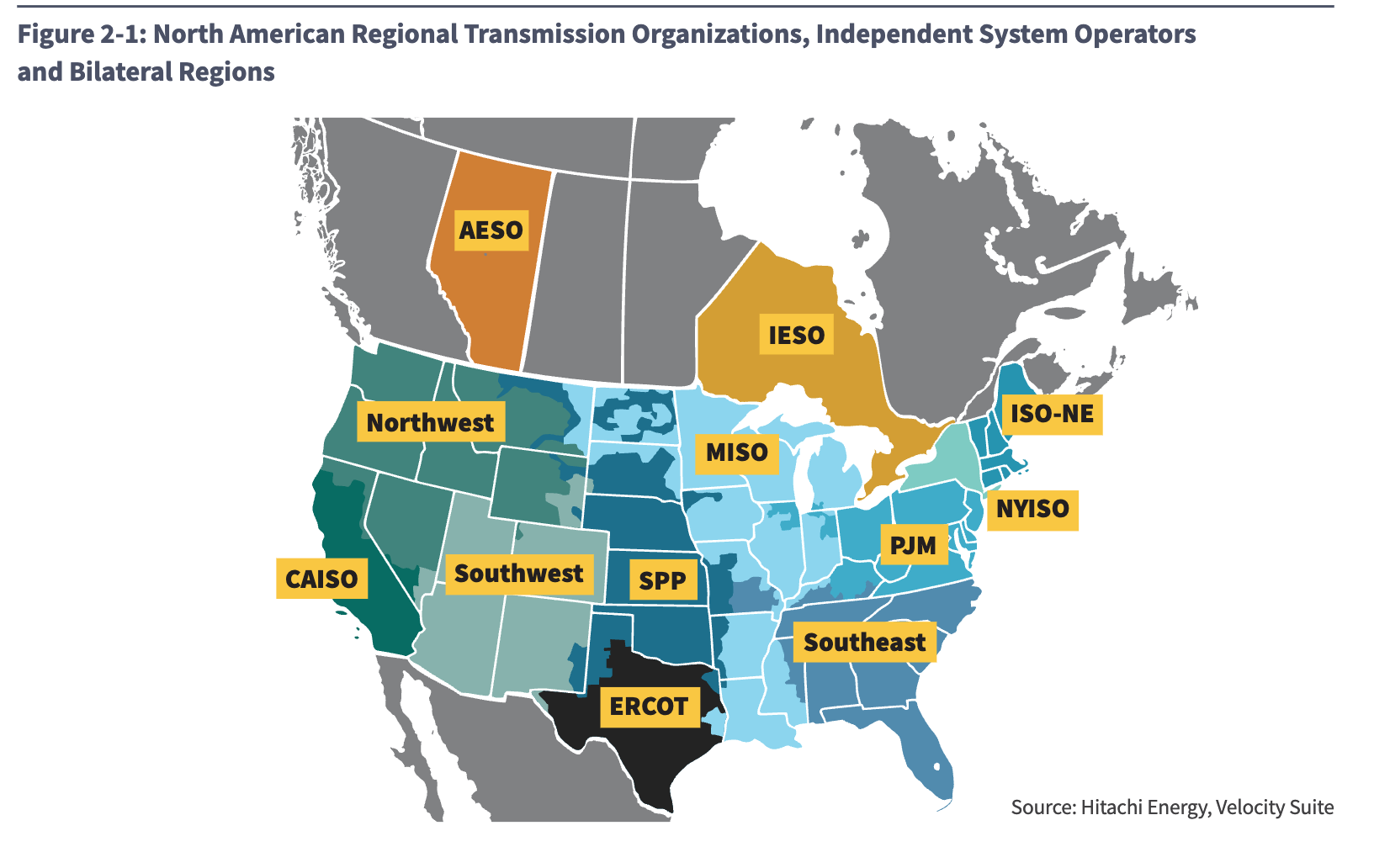
And in the ‘90s, as part of unbundling, a wave of new federal orders to break up that monopolistic control included one forcing utilities to open up their transmission lines to competitors. It’s at this stage that we start to encounter regional electricity markets, which aim to “[facilitate] open access to transmission” and “[foster] competition for electricity generation.”
All of that background leads me to the second question, and brings us to Order 1000, a rule issued fifteen years ago by FERC. This rule mandated transmission competition. Under it, incumbent utilities could no longer rely on the “right of first refusal;” that is, existing utilities could no longer have the first option to build transmission projects. Instead, for the most part, those projects had to go out to bid.
But regulation crosses both federal and state lines, and Order 1000 allows states to expressly keep right-of-first-refusal (ROFR) for incumbent utilities if they wish. About a dozen states, largely in the Midwest, have done so, according to the National Conference of State Legislatures.
Some of those states with ROFR laws are our neighbors, including Michigan and Minnesota. In Iowa, a legal challenge reached the state Supreme Court, which remanded it back to a lower court that enjoined the law (before remanding, the Iowa Supreme Court described both the law and the process by which it was passed, buried within an appropriations bill, as “quintessentially crony capitalism.”) Illinois nearly adopted a similar law in 2023, but it was met a veto from Gov. Pritzker.
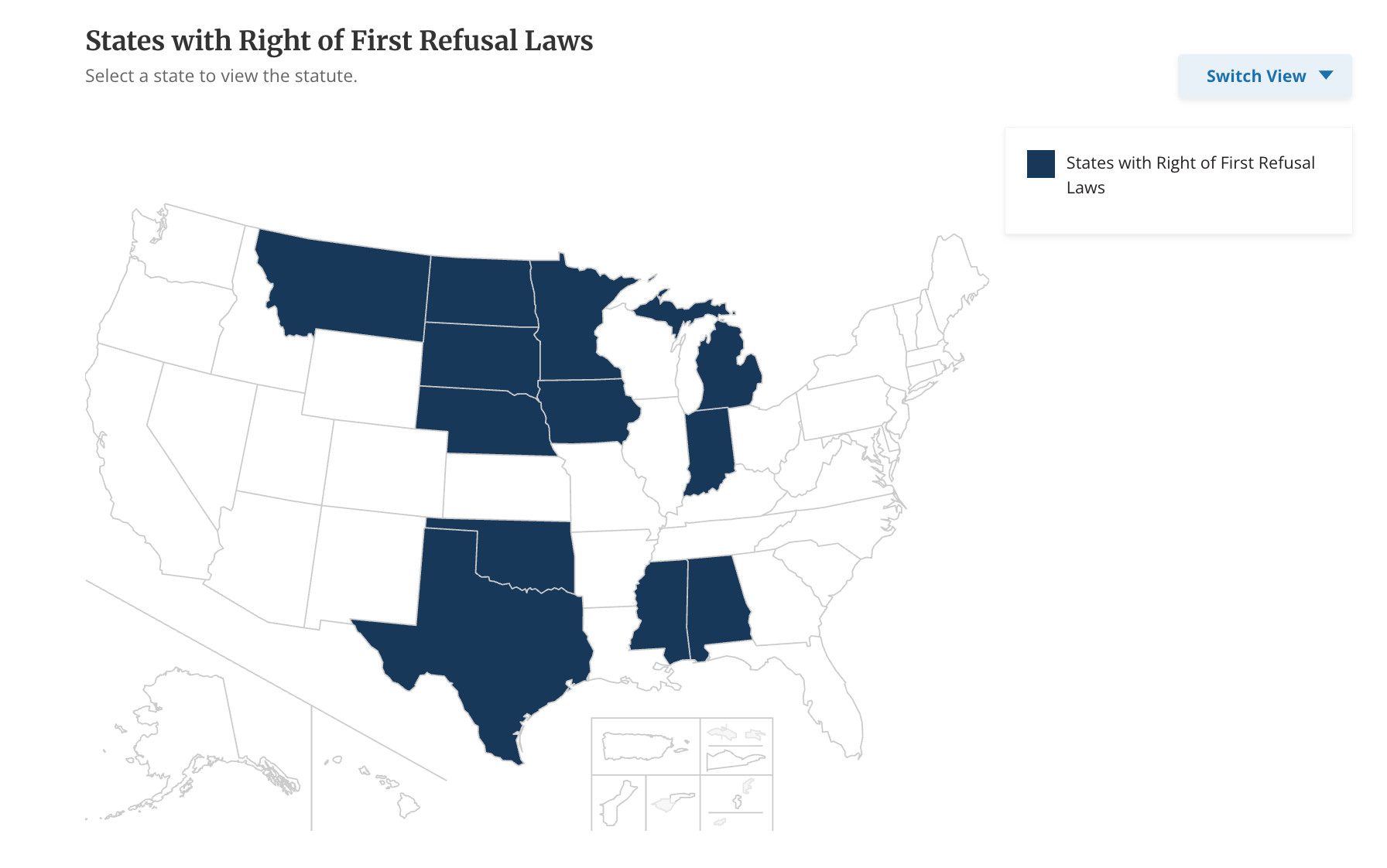
Wisconsin doesn’t have a law enshrining the right of first refusal. Yet.
Last year, a ROFR bill appeared in the state Legislature. It never managed to make it out of committee, but did get a public hearing, where supporters argued that the time spent on competitive bids added costs, and opponents argued the opposite: that eliminating competition would increase costs.
Opponents united strange bedfellows. The Citizens Utility Board said: “Please don’t remove a tool in the toolbox for cost savings for customers already facing energy inflation.”
The Wisconsin Institute for Law and Liberty was blunter: the proposal is unconstitutional, it “impermissibly discriminates against nonresident companies,” and is “a bad policy that will drive up costs for ratepayers.”
Both AFP and AARP opposed it, the latter writing that it’s “legislation that would give monopoly utilities and the utility-owned American Transmission Company the exclusive right to build large new regional transmission lines, to the detriment of ratepayers.”
The full public testimony reaches 193 pages. It also includes extensive analysis from University of Tulsa professor Eric Olson, Founding Director of the Center for Energy Studies, whose work studying transmission issues has popped up elsewhere. In his analysis, Olson takes aim at how purported cost savings are described:
“ATC argues that its incumbent status allows it to offer cost-effective solutions for transmission development compared to new entrants. However, this claim relies on a misleading interpretation of cost savings, which actually represents cost shifting rather than a true reduction in expenses,” Olson concluded.
But the fight for ROFR ain’t dead. It’s just moved back to federal regulators.
Last week, I shared with you in a news brief that ATC and Xcel Energy, which own and operate transmission lines here in Wisconsin, are among a coalition of transmission utilities that have asked FERC to temporarily pause competitive bidding in order to “win the AI race.” (Wisconsin Watch also covered it.) But it’s worth spending the time to read more of the complaint, as it echoes the same breathless time crunch inherent in data center proposals on the ground in Wisconsin.
The complaint was filed last week by a coalition of transmission companies calling themselves the “Grid Acceleration Coalition.” In total, the coalition includes the International Transmission Co., Michigan Electric Transmission Co., ITC Midwest LLC, ITC Great Plains, Ameren Services Co., American Transmission Co., Cleco Power, Entergy Services, Evergy, Oklahoma Gas & Electric Co., Empire District Electric Co, and Xcel Energy.
The coalition is hoping federal regulators loosen rules requiring competition in two of the regional transmission operators, or “grids”: the Midcontinent Independent System Operator (MISO), which Wisconsin belongs to, and the Southwest Power Pool (SPP). These two grids represent most of the Midwest, and the areas where, new research this week finds, most new data center proposals are coming.
This complaint uses some particularly grand language. It’s about “whether our country will seize, or squander, a generational chance to own the next century while also fulfilling the most fundamental obligation of utilities,” begins the introduction. If successful, “we will win the race to achieve dominance in artificial intelligence.”
The phrase “AI race” is mentioned 88 times, and all that’s stopping us from winning it, say these transmission companies, is building electricity infrastructure fast enough. They say the requirement for solicitation is “bureaucratic red tape” that’s created an average of more than 16 months of delays. These days, competition has become a “morass;” the solicitation process “unjust,” and “unreasonable.”
It goes on. Demand for energy is “increasing at a rate unseen since World War II,” and these new “expressways of power” are akin to the interstate highway system built under Eisenhower. SPP itself, they argue, says that the “region is on the precipice of a resource adequacy crisis,” which threatens the reliability of electric power. And AI leaders are complaining that available power is their biggest constraint. Microsoft has “a bunch of chips sitting in inventory that [it] can’t plug in,” according to CEO Satya Nadella (this week, Microsoft plugged in at least some of those chips in Mount Pleasant, and ahead of schedule).
As mentioned last week, there’s the dust-up in Port Washington. Despite the process feeling plenty speedy to residents there, the buildout of substations to power Vantage’s Lighthouse complex could have happened more than a year earlier without the solicitation process.
“Had MISO directly assigned the substations to ATC, ATC could have commenced development upon the MISO Board’s approval in December 2024. Instead, the project underwent solicitation and was assigned to a nonincumbent developer—one with vanishingly little experience and not even authorized to operate in Wisconsin,” writes the complaint.
“Ultimately in March 2026 portions had to be re-assigned to ATC anyway, after MISO conducted a Variance Analysis (at ATC’s request) and determined that the nonincumbent could not meet the December 2027 in-service date for certain facilities.”
MISO re-awarded the project to ATC last month.
And then there’s a project, from Xcel, to build 765 kV transmission lines from South Dakota, through Minnesota and Wisconsin to Iowa. Minnesota and South Dakota have ROFR laws, meaning they can “move into development without a solicitation delay.” Wisconsin and Iowa do not, meaning the process will be delayed “by approximately 20 months relative to a scenario where the responsible developer could proceed immediately.”
FERC has two options to deal with the time crunch, write the complainants. Either order MISO or SPP to determine whether the solicitation process would delay interconnection or transmission service, or temporarily suspend solicitation in this “most critical time period.”
And “because time is of the essence,” the Grid Acceleration Coalition says, they want a decision by mid-July. In the world of energy regulation, that qualifies as fast-track processing. This week, a number of other transmission companies, and even some states’ public service commissions, have filed requests to intervene.
There’s one last tidbit when reading the complaint. Last week, I shared some of the testimony from ATC. This week, I’ll share some of the testimony from Dean Woodley Ball, who’s held fellowships at the Federalist Society, the Heritage Foundation, and the Foundation for American Innovation. He’s acted as an AI advisor to the Trump Administration and last year wrote the administration’s AI Action Plan, along with helping draft an Executive Order to accelerate federal permitting of data center infrastructure. He and I have at least two things in common: we both have a Substack, and we both have read Oakeshott.
The AI race, says Woodley Ball, is comparable to the Soviet space race. And key to winning it is ensuring that data center construction, energy generation, and electricity transmission “can keep pace with AI’s exponential growth,” in part by removing the “regulatory barriers that could push American companies to build abroad.” Or in other words, “the infrastructure competition is inseparable from the AI competition itself.”
If data center growth feels fast, that’s because it is. It could very well be a race. But there’s another reason transmission companies might want to move fast and suspend competition: “transcos” can start charging customers as soon as they start building, under a tool called CWIP, or Construction Work in Progress. That means you the consumer start paying the cost as soon as construction starts.
Originally, CWIP “was pitched as a practical tool to encourage construction,” writes Eric Olson, the same economist who analyzed Wisconsin’s ROFR bill, in a co-authored piece. But in practice, “[CWIP] has produced inflated budgets through undisciplined spending and pushed risk from investors onto ratepayers.”
Email cutting off? Head to wisconsindata.substack.com to read this full post in the app. If you know someone who’d like to subscribe, why not share it with a friend or colleague?
Wisconsin news in brief
💬 Dem. candidates give their data center spiel
Candidates in the Democratic primary for governor again stated their positions on data centers on Tuesday, in a candidate forum hosted by Citizens Action of Wisconsin (WPR, WisPolitics, forum video).
It’s not the first time the candidates have been asked, and it’s definitely not the last. It’s also perhaps not the worst idea to track how their positions on data centers shift in reaction to evolving polling and messaging advice.
I find it difficult to paraphrase these candidates on such a complex issue, and when each lists a number of ideas and perspectives (some of which are infeasible or impossible). To that end, I’ve transcribed their exact answers in the below guide to use as a resource.
⚡ More pushback on MariBell transmission line
Vernon County officials are exploring whether to pool resources with neighboring Crawford and Richland counties to oppose a high-voltage transmission project in the Driftless, reports the Vernon Reporter.
The MariBell proposal would route roughly 140 miles of 765 kilovolt transmission line from Marion, Minnesota to Bell Center, Wisconsin. It’s being proposed by Dairyland Power Cooperative and NextEra Transmission, who say the project is “part of a larger effort by MISO… to maintain a resilient and flexible electric grid.”
😷 Hearing on Port Washington air quality permits
Also on Tuesday, the DNR held a public hearing for air quality permits at the Vantage Stargate campus in Port Washington. Those permits are necessary for the hyperscale data center to run 45 diesel generators in the event of a power outage (WPR).
At the hearing, residents weighed in, saying that their existing ozone pollution was already at capacity (Wisconsin Examiner). For more on the air quality / data center nexus, see this edition of the Data Processor.
💰 On the lawsuit from business groups
Remember that initiative in Port Washington to block the future use of tax increment financing for large-scale projects? The one that voters put on the ballot, then approved, earlier this month?
Business groups are still seeking to block its implementation. The case had a scheduling conference on Thursday. Unfortunately, Ozaukee County does not appear to be one of the many counties where you can livestream court proceedings, but it appears a trial has been set for September 16.
Those suing include the following groups that have a stake in large-scale development, including business, contractors, construction labor, developers, realtors, and — uniquely — a Port Washington-based waterproofing business:
- Metropolitan Milwaukee Association of Commerce, Inc.
- Associated General Contractors of Greater Milwaukee, Inc.
- Building Advantage
- Commercial Association of Realtors Wisconsin, Inc.
- NAIOP Wisconsin Chapter, Inc.
- Wisconsin Realtors Association, Inc. and
- Sids Sealants LLC & Sid Arthur
Some of these groups have lobbied on other data center bills this session. The Metropolitan Milwaukee Association of Commerce, for example — whose CEO is former Republican lawmaker Dale Kooyenga — lobbied on several data center bills this session. Including to lift the 12% cap on the Port Washington TID, and indeed to lift the cap on all TIDs where there’s a qualified data center, expand tax exemptions to colocated data centers, and perform perfunctory checks on areas of data center controversy.
📄 What is driving electric cost increases in Wisconsin?
Bill Skewes wants to set the Wisconsin Legislature straight. On Wednesday, the Executive Director of the Wisconsin Utilities Association sent a memo to state lawmakers.
Electric costs are rising, Skewes says, because a multifactored set of conditions in building, maintaining, and financing the electric system are rising: replacing aging infrastructure, hardening the grid against more frequent severe storms, building new power sources to eventually retire coal, higher construction and labor costs, higher borrowing costs, and volatile fuel markets.
Only when we reach the seventh and final point do we see another factor: data centers. According to the memo, “new large customers—especially data centers—require: new substations, higher capacity lines, [and] additional generation and backup capacity.”
And even if most of those costs are paid by large customers, it still raises the overall infrastructure costs for everyone, the argument goes. When I asked, Skewes couldn’t point to a single event that precipitated sending the memo. Instead, he said, this was an active area of public attention and debate.

What Is Driving Electric Cost Increases In Wisconsin
112KB ∙ PDF file
🗄️ Microsoft’s Fairwater data center goes live
In Mount Pleasant, Microsoft’s Fairwater data center has reportedly gone live, according to CEO Satya Nadella. I can’t find any independent reporting to confirm it.
Elsewhere on the internet
- Moment of Truth: Sam Altman may control our future. Can he be trusted? Ronan Farrow and Andrew Marantz profile Sam Altman, CEO of OpenAI, in a luxuriously researched piece for The New Yorker. They also discuss their painstaking research and methods in a recent podcast.
- The US government will ask data centers how much power they use. The Energy Information Administration is planning to develop a mandatory inventory of data center energy use, reports WIRED. But they’re going to run before they walk. Last month, the EIA announced it would conduct a pilot survey in Texas, Washington, and Virginia/DC. According to a letter sent to Sens. Liz Warren and Josh Hawley, the EIA plans to announce a “second tranche” of pilot surveys soon.
- Anthropic opposes the extreme AI liability bill that OpenAI backed. A proposed Illinois law would let AI makers off the hook for mass deaths and financial disasters, reports WIRED, signaling fission between AI developers. The bill, SB3444, is one of roughly 50 AI-related bills in Illinois right now. And that’s just the bills filed in 2026, according to a coalition tracking AI transparency across the US.
- Most new data centers in the U.S. are coming to rural areas. Pew Research has some new numbers: 67% of planned data centers are in rural areas, and the Midwest has 419 planned data centers and 655 existing ones. To my chagrin, this research does not distinguish between type of data center. Nor does its underlying sourcing from datacentermap.com. For more on types of data center, see this edition of the Data Processor.
Events in brief
- Tuesday, April 21: Rock County Data Center Town Hall (Blackhawk Tech College, 6-8pm). Organized by No Beloit Data Center, featuring Charlie Berens. More information here.
- Wednesday, April 22: Data Centers in Grant County (Lancaster, 7pm).
The Grant County Farm Bureau will host an informational meeting on data centers. - Wednesday, April 22: Understanding AI: A Forum for Local Government (Oshkosh, 8am-3:30pm). Part of a series of forums for local government presented by UW Extension. Topics include how to use and mitigate risks posed by generative AI, and the basics of data centers. $50, and register.
- Wednesday, April 22: Water@UW-Madison Spring symposium (Madison, 2-5pm).A data science professor will given an overview on the “good, bad, and complicated” of AI use. A water policy expert will present on the “hidden environmental costs of AI data centers.” Free, but register.
- Thursday, April 23: ICE and Data Centers (Sheboygan, 6pm).
Labor organizer Ric Urrutia, co-host of the Wisconsin Labor Podcast, will present in Sheboygan on what he terms the “interlocking corporate and banking interests of ICE and data center owners.” More info. - Friday, April 24: ICE and Data Centers (Manitowoc, 4pm).
Labor organizer Ric Urrutia, co-host of the Wisconsin Labor Podcast, will present in Manitowoc on what he terms the “interlocking corporate and banking interests of ICE and data center owners.” More info. - Monday, April 27: Brownfield basics (Janesville, 5:15pm). The last in a series of data center workshops. More information here.
- Thursday, April 30: Wisconsin Tech Summit (Oshkosh Corp. headquarters, $$). This year’s annual summit is focused on AI in industry, especially in health care, finance, ag, energy, and manufacturing. Remzi Arpaci-Dusseau, of UW-Madison’s new College of Computing and Artificial Intelligence, will deliver a keynote. Full speaker list here, and more info.
That’s all for now!
This weekly newsletter is attempting to do something a little different: round up the data center news across Wisconsin, and present the patterns that emerge.
I’m starting this out of a personal habit of aggregating developments and data center news, and a way to organize notes for longer research projects. Then I figured, why not share the notes with you?