
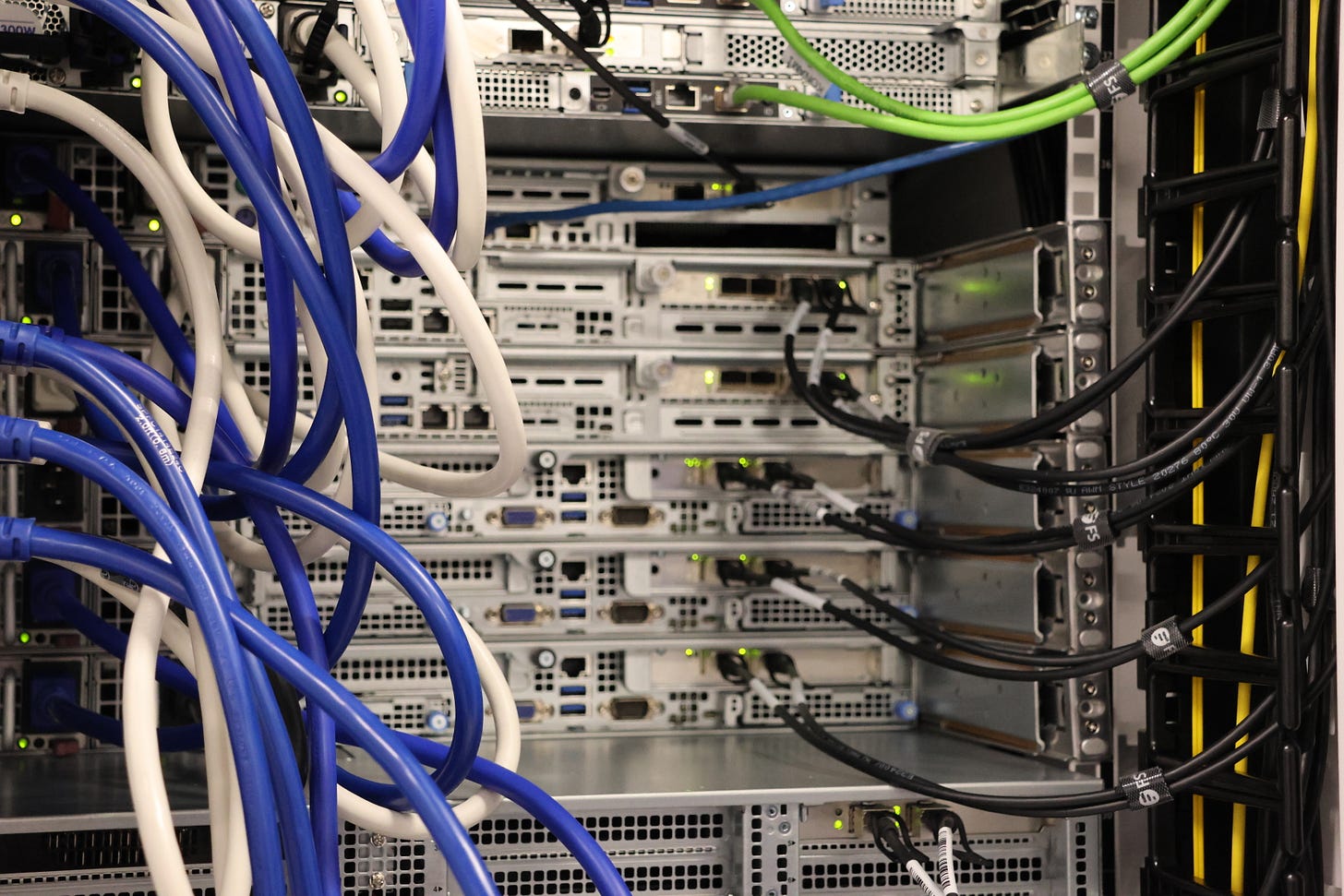
Data center typologies
The phrase “data center” may have suffered some linguistic slippage.
News reports, for example, will cite datacentermap.com to say that there are now 52 data centers in Wisconsin. But dozens of those are not the ones generating headlines and community controversy. Many of them have been in Wisconsin for decades.
“Rooms that house computers have been around long before we started talking about data centers as a large server room,” said Terry Bradshaw, Data Center Service Lead at UW-Madison’s Department of Information Technology, in a presentation to a Dane County advisory committee on data centers last month. He says there are four main categories we can use to think about these facilities. So let’s start there.
The first is an enterprise data center, which is operated for the purposes of one entity — like a hospital system or a university. UW-Madison’s data centers, for example, fall in this bucket.
Already, this can start to make regulation complicated. In January, the city of Madison imposed a one-year moratorium on data centers, and the city hasn’t had a separate “data center” category in the zoning code. City planners are still working to get an accurate count of the number of data centers in the city as they more broadly develop recommendations for zoning.
Since the moratorium was approved, some businesses with existing data centers supporting their operations have reached out to the city, says Meagan Tuttle, director of Madison’s planning division, who spoke with me this week. They were, she says, “interested in understanding what the moratorium means for them, in terms of continuing to operate the businesses that they are already running.”
I asked her how these facilities might be zoned right now. Standalone facilities, she says, would have likely been regulated as a telecommunication center in a commercial use zoning, Something like an office building with its own server room would have likely been considered an accessory use.
The next type of facility is a colocation center, which you can think about as a hotel or apartment building. It’s a business that rents you space, power, temperature controls, and other infrastructure. You just use a portion of the building for your own servers, and your own data.
Colocated data centers, though, don’t get the same tax breaks. Last week in our legislation round-up, I mentioned a bill to amend the definition of a “qualified” data center so that these types of facilities, if over 25,000 sq. ft., would be eligible for sales and use tax exemptions made possible in the 2023 state budget.
Ark Data Centers is a national colocation data center provider. It has a 24-acre campus in a village near Green Bay, and wants to expand. But, said Ark’s interim CEO John Kehoe in testimony, it didn’t get the deal that large-scale data centers with a single tenant currently enjoy. Consequently, Ark says it had no option but to cancel investments and divert customers to other states with tax breaks. The bill, by the way, failed.
Ark is also an edge data center, our third typology. In an information economy, speed is everything, and edge data centers prevent lag. This type of data center gets information physically closer to the end consumer, reducing the physical transmission time, and making your Netflix streaming eminently less choppy.
And then our fourth typology: hyperscale data centers. These, says Bradshaw, “take everything up to eleven.” The elements aren’t so different from the above — they can be an enterprise or colocated center — but they’re just much bigger.
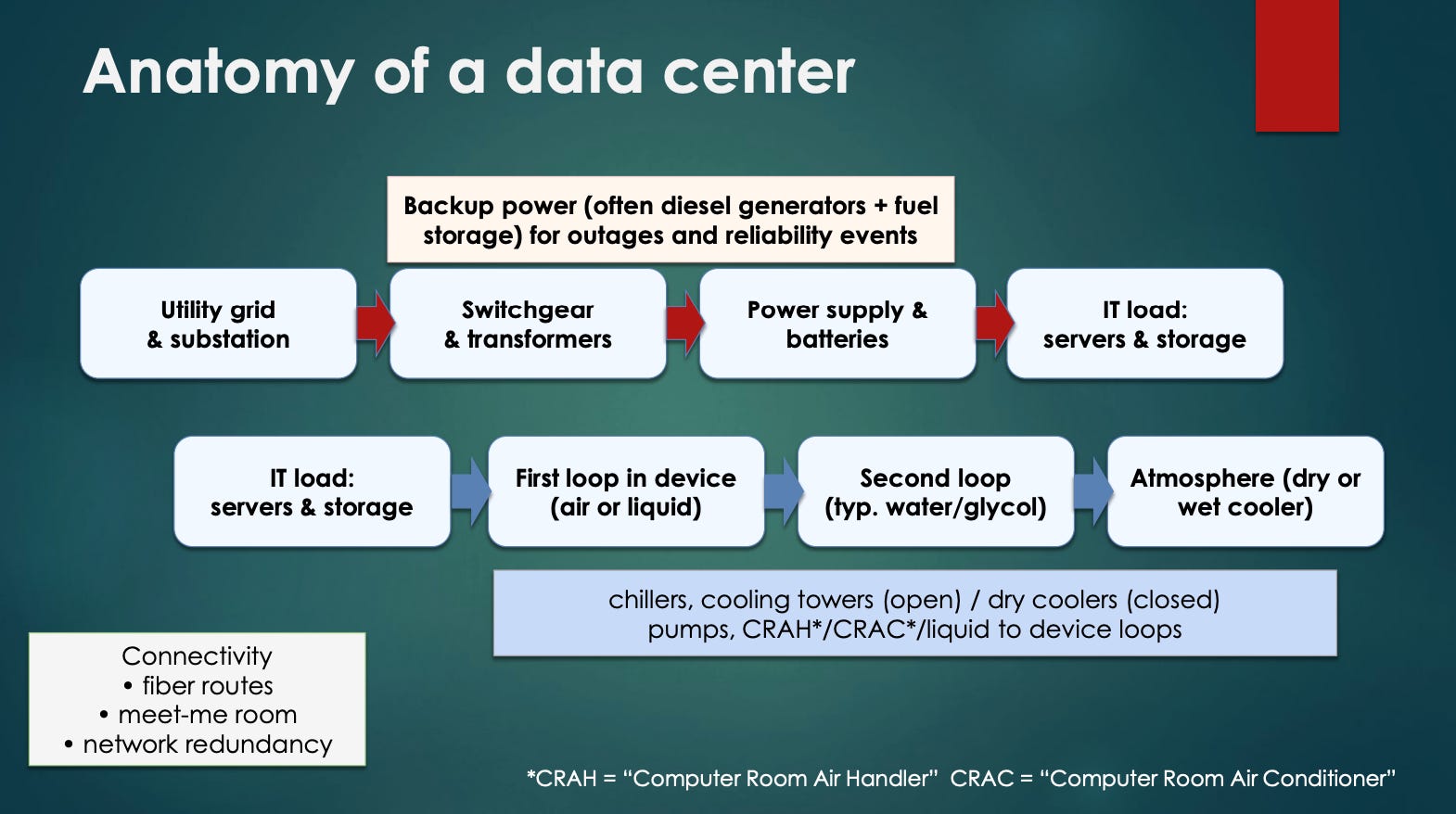
Beyond these categories, though, the physical components of a data center can be similar in need, though different in execution. There’s the whitespace of the server room, where all the data actually lives. There’s the power infrastructure: the utility grid, substations, switchgear, transformers, etc. that are keeping the data online. There’s back-up power, the UPS batteries or even diesel generators for outages.
Then there’s the cooling, which Bradshaw explains usually happens on two loops. The first loop pulls heat away from the individual chips, traditionally through fans circulating air, though the industry is increasingly moving to coolant that’s “direct to chip.” The second loop takes the heat directly out of the room, and to somewhere else — usually the atmosphere. (Researchers recently looked at the change in surface temperatures near hyperscale data centers).
Bradshaw says that the second loop typically runs on what is, essentially, antifreeze. There’s a mix of water and ethylene or propylene glycol. UW-Madison’s main facility has about 5,000 gallons of coolant in its loop, and since 2009, they’ve never done a full flush of it.
The exception here is what’s called an open loop, which uses evaporative cooling, and performs the work that electricity would otherwise do. And it’s a tradeoff: strategies that reduce electricity consumption can tend to increase water consumption, and vice versa.
A large open-loop system might use millions of gallons a day, but it uses less electricity that it would otherwise need to cool. Neither option is free. (Check the events calendar below for details on an event next week on the energy-water nexus.)
So those are the non-exclusive buckets for thinking about data centers. And it’s the set-up for our installment next week, when we’ll actually go inside a data center.
It’s a data center its operators say was done right, with sustainability at the forefront. One that is profitable, but not with profits driving the design. And while it’s outside the state of Wisconsin, it’s only a 75 minute drive away.
Other news in brief
Governor Tony Evers was on a bill-signing marathon on Thursday, April 2, signing his approval on some legislation related to data center and energy.
Among the most interesting is a sales and use tax exemption for nuclear fusion. The bill was endorsed by several industrial groups and by Madison-based Realta Fusion, one of dozens of companies that are “leveraging the latest scientific breakthroughs to put fusion power plants on the grid by the mid-2030s,” Realta’s CEO and co-founder wrote in public testimony on the bill.
Nuclear energy groups are “receiving enormous amounts of cash investment” to meet the demand for nuclear fusion, and nuclear fusion investors “are often the same tech companies that are involved in building data centers for AI projects,” reports Wisconsin Public Radio (How Wisconsin’s data centers could be powered with fusion energy in the next decade | January 22, 2026)
Another bill signed into law will extend Wisconsin’s existing “utility aid payment” system to cover energy storage facilities: hydroelectric, compressed air, regenerative fuel cells, batteries, and liquefied natural gas.
The payments are from the public utility account, a fund within the state’s shared revenue system that compensates local governments for hosting utility infrastructure they can’t put on their own property tax rolls.
In testimony, WEC Energy Group said the bill “ensures that communities that host modern energy projects are fairly compensated.”
MG&E said it would benefit communities where the utility owns or plans to own battery capacity, including the Paris Solar Battery Park in Kenosha County, the Sunnyside Solar Energy Center in Fitchburg, the High Noon Solar Energy Center in Columbia County, and the Darien Solar Energy Center in Rock and Walworth Counties.
The payments are slated to take effect in 2027.
Speaking of liquified natural gas, the Town of Rock Zoning Commission reportedly tabled a conditional use permit application for a plant proposed by Alliant, following a public hearing the same night.
It’s rate hike season. The Milwaukee Journal Sentinel reports that We Energies is seeking a rate hike for residential and business customers. If approved, it would be the sixth rate hike since 2020. (We Energies seeks 14% residential electric rate hike by 2028 | April 1)
We Energies says under the hike, “the typical residential electric bill is projected to increase about $13 per month in 2027 and $8 to $9 per month in 2028.”
Also, We Energies is considering delaying the closure of its Oak Creek coal plant until 2027, the Milwaukee Journal Sentinel also reports (We Energies delays Oak Creek coal plant closure again | Friday, April 3)
One of the biggest concerns voiced by attendees at a virtual town hall on Wednesday, hosted by Citizen Action of Wisconsin, was the “pressure that data centers’ massive energy use will put on regular Wisconsinites’ energy bills and the effect that increased energy use will have on the climate,” reports the Wisconsin Examiner in a recap. (Wisconsinites decry data center effects on utility bills, climate in online town hall | Thursday, April 2)
Charlie Berens is definitely not running for governor, but he’s still a vocal opponent of hyperscale data centers. In a prank platform, the comedian/journalist calls for no NDAs for AI data centers along with “lobbying in Kohl’s Cash only.” (bratsnotbots.com | Tues. April 1)
Energy economics professors Jason M. Walter and Eric Olson break down what’s known as CWIP, or construction work in progress, in a special in the opinion section of the Milwaukee Journal Sentinel. Simply put, CWIP is a mechanism that means consumers fund infrastructure as it’s being built. A few months ago, the professors tracked legislation in Wisconsin and other states that would allow consumers to start paying for project costs before those projects are even approved. (Why should WI pay for data center costs before they exist? | March 31)
A new study looked at temperature data near thousands of hyperscale data centers. Researchers at the University of Cambridge found a correlation of a several-degree rise in surface temperatures. As caution, the study hasn’t been peer-reviewed. (CNN: Scientists have found an alarming environmental impact of vast data centers; The Independent: Data centers are creating ‘heat islands’ on land around them | Tuesday, March 31)
The Beaver Dam Plan Commission has recommended changing the boundaries of a TIF district, making way for a second data center, this one a 90,000 sq ft edge data center. More expected at next Monday’s council meeting. (Daily Dodge: Plan commission sends TID 7 change to Beaver Dam common council | March 26, 2026).
Meanwhile, representatives from Meta, Alliant, and the Beaver Dam Area Development Corporation joined WBEV for an interview on Thursday. Despite the name of the program, there wasn’t much room for community comment. The guests requested not to take listener calls.
Manitowoc County is closer to establishing a one-year moratorium on permitting data centers, reports Wisconsin Public Radio. It still would have to be approved by the county board, and a vote is expected later this month. But as in other counties (including Dane!), towns that have opted out of county zoning would be on their own.
Cloverleaf’s chief development officer says “We continue to see northeast Wisconsin as a good opportunity for data centers due to proximity to infrastructure and generation assets in the region.” (Manitowoc County committee recommends 1-year moratorium on data center permitting | Friday, April 3)
Politico’s energy and environmental desk drops in on Janesville, meditating on the fact that former industrial properties classified as brownfields might make sense for data centers given their water and power infrastructure.
It also notes this: in January, the EPA published guidance on redeveloping Superfund and brownfield sites as AI data centers.
And this: In late 2024, Janesville sought a $20 million grant to redevelop the site. The program was canceled by the Trump Administration. (No one wanted to redevelop this polluted property. Then came AI. | Monday, March 30)
Events in brief
- Wednesday, April 8: Data Centers and the Energy-Water Nexus (Lubar Center, UW-Milwaukee, 9am). A panel on the connection between energy generation and clean water will include the Citizens Utility Board, Milwaukee Riverkeeper, and WEC Energy Group; moderated by David Strifling, director of the Water Law and Policy Initiative, and lawyer and professor Art Harrington.
- Tuesday, April 14: Data Centers and a Sustainable Future (Madison, 8am)
Sustain Dane will host a breakfast series in Madison on data centers and a sustainable future (note: QTS has maintained its $1.5 million commitment to UW researchers on data center sustainability). Register. - Tuesday, April 14: Dane County Advisory Committee on Data Centers (Madison, 12pm). Dane County’s advisory committee on data centers will hold its monthly meeting.
- Tuesday, April 21: Rock County Data Center Town Hall (Blackhawk Tech College, 6-8pm). Organized by No Beloit Data Center. More information here.
- Wednesday, April 22: Data Centers in Grant County (Lancaster, 7pm).
The Grant County Farm Bureau will host an informational meeting on data centers. - Thursday, April 23: ICE and Data Centers (Sheboygan, 6pm).
Labor organizer Ric Urrutia, co-host of the Wisconsin Labor Podcast, will present in Sheboygan on what he terms the “interlocking corporate and banking interests of ICE and data center owners.” More info. - Friday, April 24: ICE and Data Centers (Manitowoc, 4pm).
Labor organizer Ric Urrutia, co-host of the Wisconsin Labor Podcast, will present in Manitowoc on what he terms the “interlocking corporate and banking interests of ICE and data center owners.” More info. - Thursday, April 30: Wisconsin Tech Summit (Oshkosh Corp. headquarters, $$). This year’s annual summit is focused on AI in industry, especially in health care, finance, ag, energy, and manufacturing. Remzi Arpaci-Dusseau, of UW-Madison’s new College of Computing and Artificial Intelligence, will deliver a keynote. Full speaker list here, and more info.
That’s all for now!
This weekly newsletter is attempting to do something a little different: round up the data center news across Wisconsin, and present the patterns that emerge.
I’m starting this out of a personal habit of aggregating developments and data center news, and a way to organize notes for longer research projects. Then I figured, why not share the notes with you?
Thanks for reading Data Processor! Subscribe for free to receive new posts and support my work.