
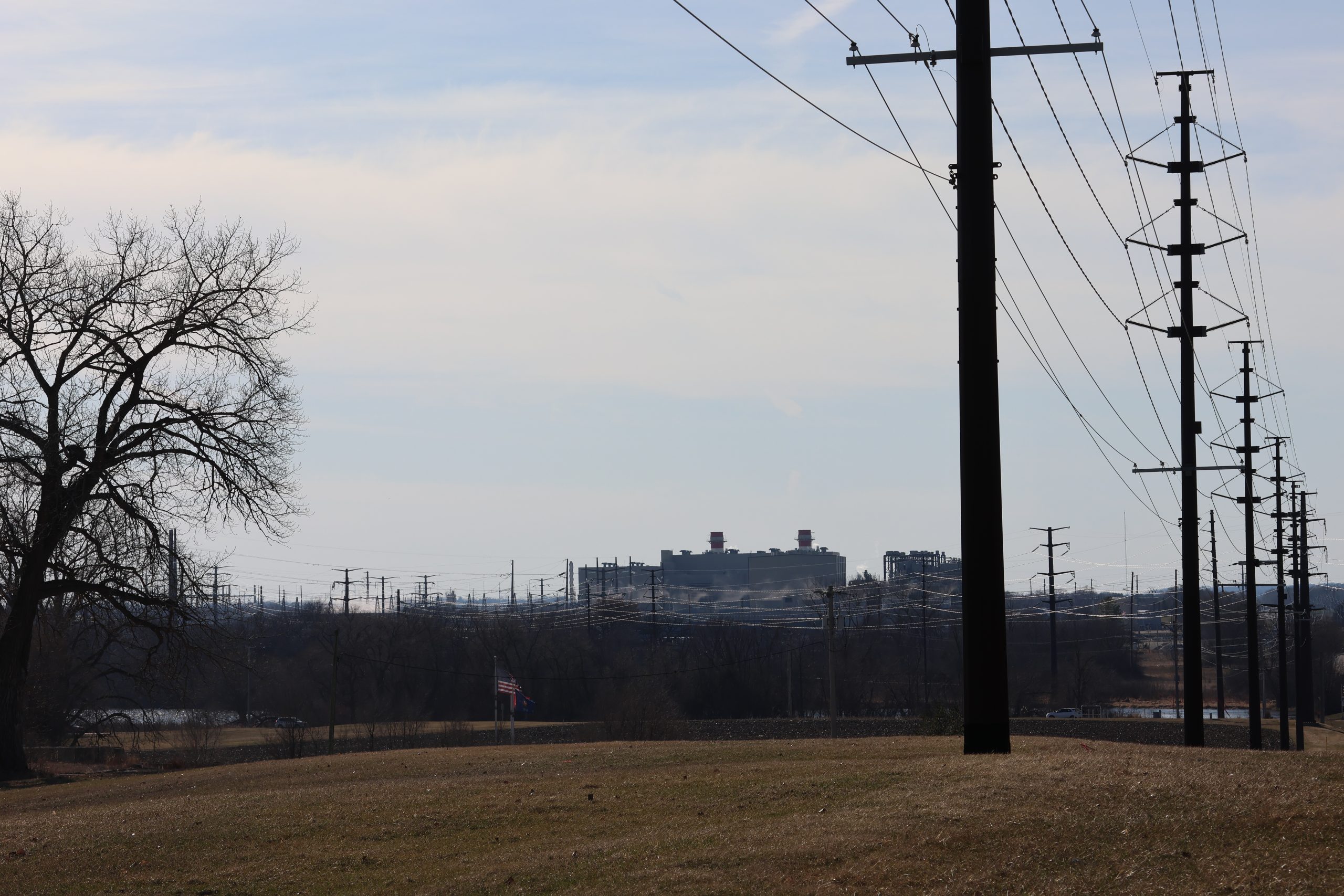
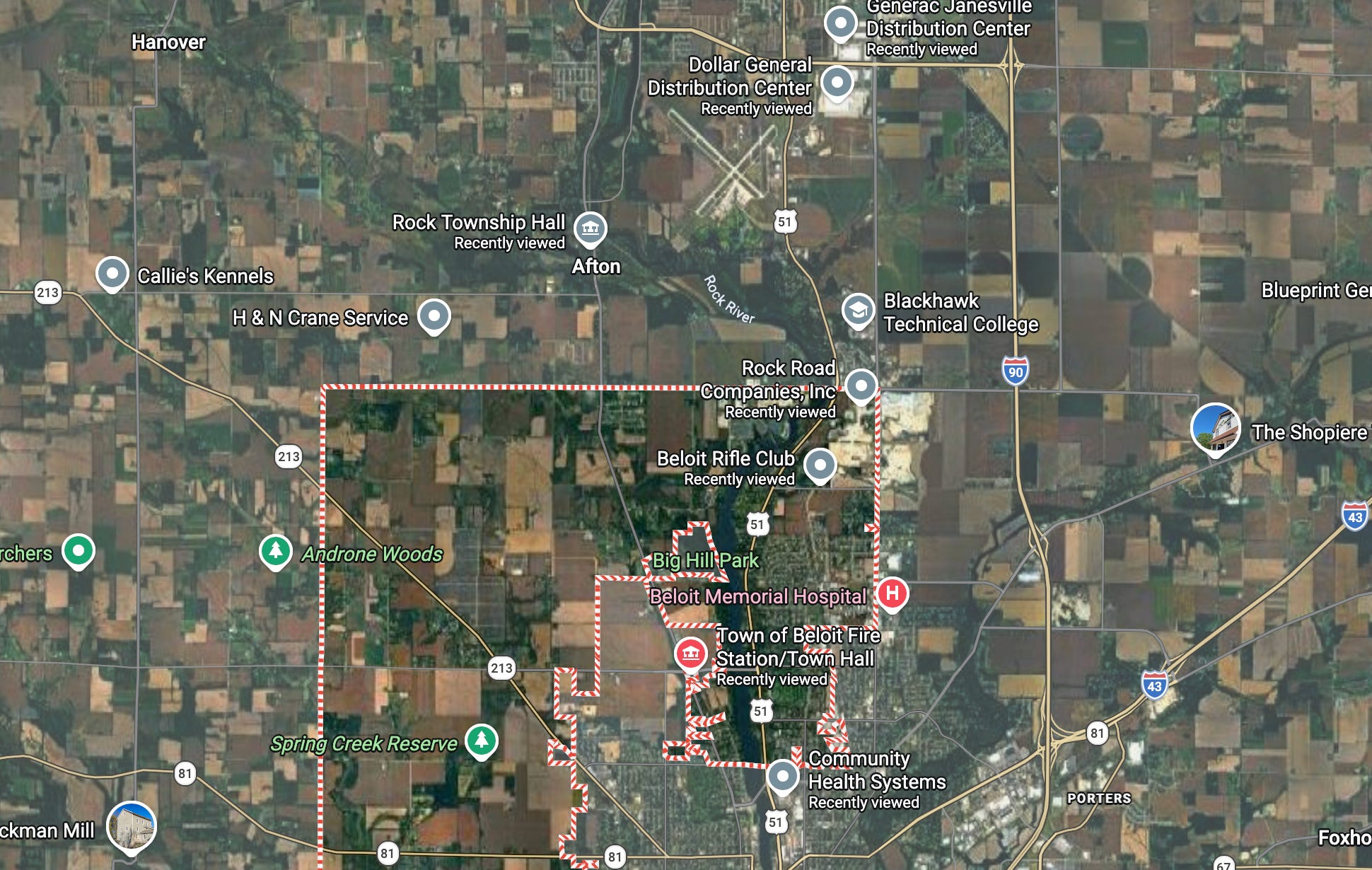
Two proposals for large data centers are before Rock County. One, a proposal from Colorado-based Viridian Acquisitions LLC to redevelop the long-shuttered GM-JATCO site in Janesville. Another, just twelve minutes south, is a preliminary plan from Meta to build in the most northwestern corner of the town of Beloit.
The first proposal is headed to a community vote this November, which city officials warn could trigger legal issues. The second is more elusive, but became public earlier this month, when WKOW reported that at least some local officials have known about “Project Cornmaze” for over a year. Last weekend, I found myself acquainting myself with the project’s potential edges.
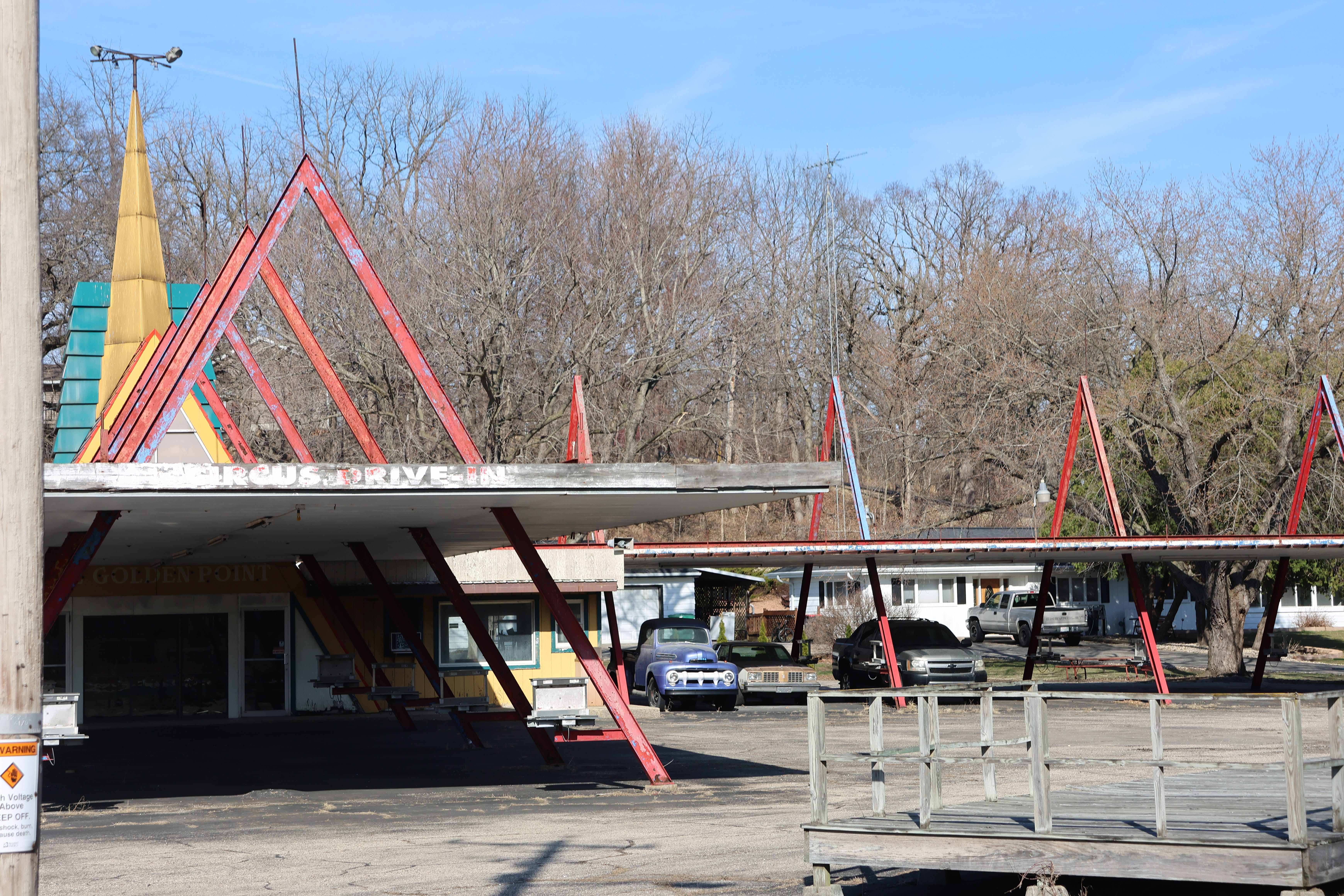
Along East Philhower Road, there’s the brown scrub of farmland, the checkered red and white of cement mixers at a concrete company, a rifle club, and a shuttered drive-in called the Circus. Just a block south is a residential community.
Along Town Road, there’s a sand and quarry pit from Rock Road LLC, a company associated with Project Cornmaze in the DNR filings. ATC lines run above. Across the road is a manufactured housing community. Just a minute north is Blackhawk Tech College, and a minute west is the Rock River.

I was there last Saturday for a town hall, attended by one gubernatorial candidate, one Janesville city council member, and a pair of organizers from Port Washington.
The basement of The Castle, a Gothic church turned community space, is also a fallout shelter. The reclaimed wooden chairs are creaky and a resident corgi named Lady is sleeping in a corner. Data center opponents are most of the crowd, and State Rep. Francesca Hong is giving a considered pause before answering this question: why are data centers coming to Wisconsin?
“In places like Beloit [and] Janesville, if we think about parts of central Wisconsin, over the past twenty some years now, we have seen a massive loss in middle manufacturing and good-paying jobs,” says Hong.
“When those jobs went overseas, when corporations once again put profits over the dignity of life that everyone deserves, we saw this decimation and decline in smaller communities which makes us more vulnerable.”
Hong is polling ahead of her Democratic competitors for governor, in a crowded primary. Data centers are one way the candidates are differentiating themselves. Hong is also one of several Democratic lawmakers this session to introduce a bill for a moratorium on hyperscale data centers. The variety of unknowns driven by the speed and scale of data center growth, she says, means “we have to hit pause.”
The legislation didn’t pass and unsurprisingly, it didn’t get a hearing in either chamber’s utility committee. Instead, it laid out a fourteen-point plan of fiscal and regulatory measures, among them: a statewide data center planning authority, mandatory reporting on water and electric use, sign-off from voters in advance, a requirement that data centers are fully powered by renewable energy, and the elimination of financial breaks that lawmakers put into place just three years ago and again this session. (Nationally this week, progressive lawmakers announced similar legislation.)
Talk of economic developments and investments, Hong says, are just that. Talk. “Why should the state go into business and take a gamble on companies that are coming in with borrowed money?” she tells the crowd. “The financing on this is deeply irresponsible.”
Data center proposals in Rock, Racine, and Port Washington have some commonalities. They’re in blue-collar parts of the state that have been hollowed out by deindustrialization. Michael Rosen, retired professor of economics at Milwaukee Area Technical College, rattled off employers to me just some of the employers that have left Milwaukee in the last sixty years: AO Smith, Briggs & Stratton, Harley-Davidson, Master Lock, Allis Chalmers. In Kenosha, the Chrysler plant, which shut down in ‘88. In Janesville, the GM plant, which shut down in ‘08.
These are just some. In the same areas, the people constructing the facilities, and (some of the) labor unions that are eager to build them, could be constructing the places that could take more jobs. A 2018 study on manufacturing trends produced by UW Extension found that under one probability matrix, almost 70% of manufacturing jobs in Wisconsin had a 60% chance or higher of being automated.
“We have no idea what AI’s impact is going to be on employment and jobs. Now we’ve seen what deindustrialization has done to the people there, and what that’s done to their futures and their children’s futures, and what it’s done to the politics of those communities. We’ve already gone through this dramatic change, and we should recognize that AI could have a similar impact on employment,” Rosen told me.
“And before we allow companies that are making money off this stuff to just rush… into it, we need to have some serious discussion and policy development to ensure that the citizens of this country are not thrown by the wayside.”
The latest controversy in Rock County this week, though, is over a tool some say limits transparency, and what others call standard economic development. During the “No Data Centers in Beloit” town hall last Saturday, one man got up during the Q&A not with a question, but with a call to action.
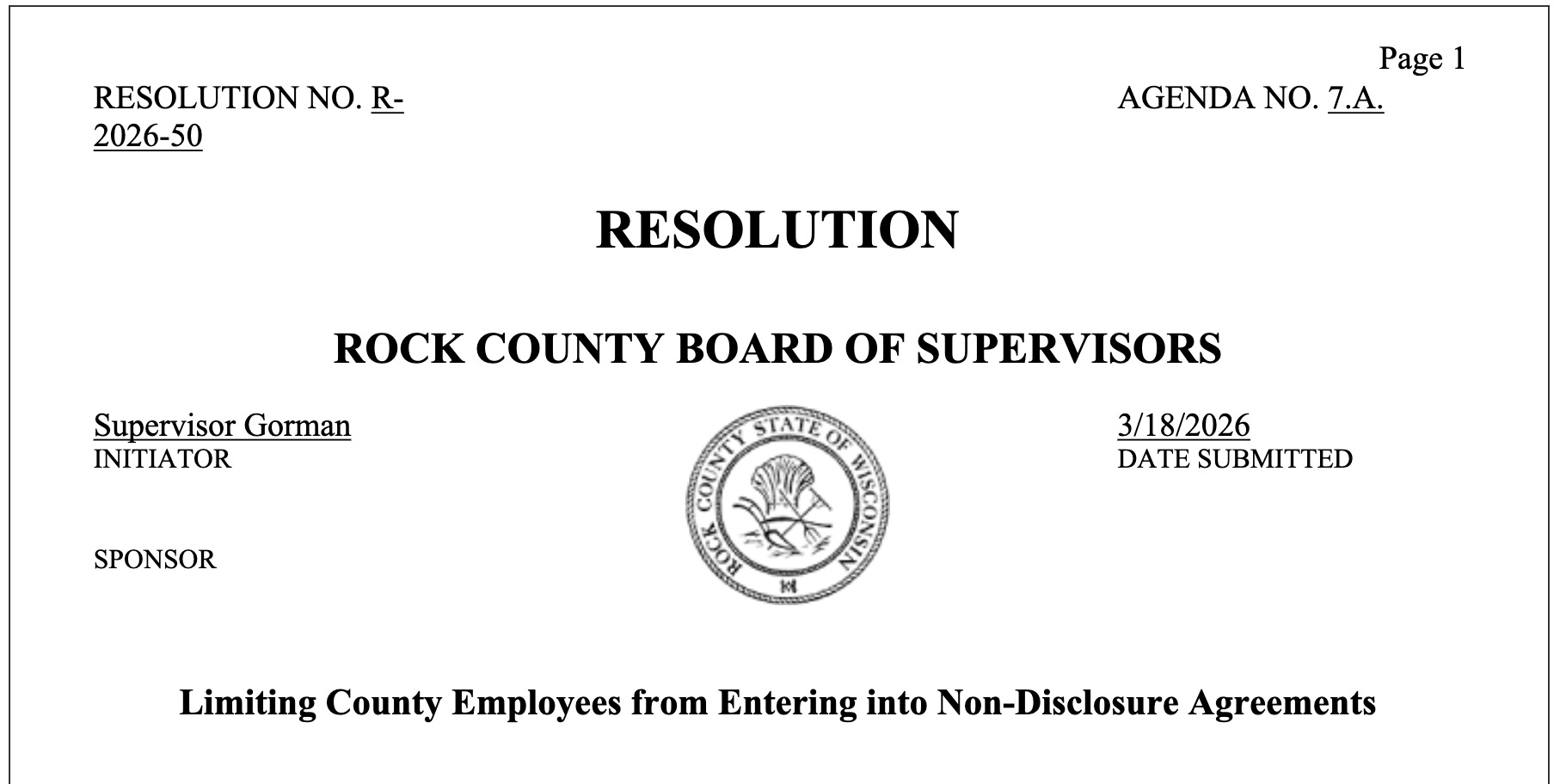
Phil Gorman is a Rock County Supervisor, representing both the city and town of Beloit, and is running for reelection this spring. He told the crowd that he found out from the media earlier this month that the Meta data center is being planned in his district. That motivated him to write a resolution prohibiting county employees from entering into NDAs in the future.
“The best way to freeze these things and kill these things is with some transparency. As soon as it gets out in the open, these companies pull out, people show up, people get educated, and they go away. And the best way to do that on the county level, on your local level, is to ban or limit these NDAs,” Gorman told the town hall crowd to applause. The New York Times reports this week that $156 billion in new data center construction has been stalled due to local opposition.
Gorman says he didn’t know that James Otterstein, the Economic Development Manager for Rock County, had signed a nondisclosure agreement related to the Meta development. Tim Wellnitz, Town Administrator for Beloit, also signed a nondisclosure agreement in February 2025 with Cambrin LLC, the company associated with other Meta projects. The agreements have been used in four other developments across the state, Wisconsin Watch reported two weeks ago.
Gorman’s resolution went before the Planning and Development Committee on Thursday, which voted against recommending it.
In testimony, Gorman explained that part of the reason for bringing up this discussion at the county level was because state or federal regulations are silent on guardrails. And he was careful to distinguish between types of agreements.
NDAs to protect true trade secrets, he says, are “perfectly fine.” But NDAs to prevent the fact that there is a project being planned, are not. Gorman says, in Wisconsin, and with data centers, NDAs are at best a delaying tactic. Under the state’s open records law, they’re not a way to keep a project permanently confidential.
One company is catching on that NDAs aren’t popular. Microsoft said last week they’d stop the practice. But some testified that Gorman’s resolution would harm the county’s ability to compete, and prevent Otterstein from doing his job.
Rock County Supervisor Chris Cullen says a ban on NDAs would be an unnecessary hurdle to doing business. “Everybody talks about transparency. That’s BS. Transparency is overrated. The hard discussion, the logical discussion, the arguing, take place in private. And you have to look at the results. I think we’re getting a carrot in front of the cart,” said Cullen. The agreements are standard business, he argued, while raising this question: aren’t we only having this conversation because of data centers?
Republican lawmakers introduced a bill this session to curtail NDAs if they’re used to conceal public details of data center deals. The Senate version made it through the utility committee, but the Assembly version was dead on arrival. Under this bill too, NDAs to protect trade secrets would still be allowed. Is it possible that, in tough competition and billions to be made, the location or size of a data center could be considered a trade secret? We didn’t get that far.
Another Rock County Supervisor, who declined to be named, tells me that NDAs are a standard tool of economic development. They also told me this: Otterstein is “not the boogeyman.”

Can Rock County’s current infrastructure handle one, two, or more data centers? For at least the GM proposal, water, says the director of Janesville’s water utility, shouldn’t be a problem. In a presentation at the start of this week, Director Dave Botts pointed to the fact that the city pumped less than half of its available capacity in 2025. And after talking with data center consultants working on Mount Pleasant and Racine projects, Botts says a closed loop system means wastewater would also not be an issue.
What about the air? Beloit’s air pollution is the worst in the nation, according to a 2023 air quality report from IQAir. But Beloit only made the list because of a community project to install air monitors.
Yusuf Adama, one of the panelists at Saturday’s town hall, is a Beloit city council member. Wisconsin’s air quality, he says, is so under-monitored that we can’t make good decisions. “We don’t have the proper information to make sure we’re doing this safely,” says Adama.
Milwaukee and Sheboygan County are listed as nonattainment areas for ozone under the Clean Air Act, according to February data from the EPA. But like Beloit, it’s tough to get all of the data.
“In some of these areas where we’ve seen a lot of proposals, either from data centers or gas plants related to data centers, we’re finding more and more that the baseline air quality is either completely unchecked and we’re going to add to it without knowing what’s really already there. That’s true for spots like Rock County,” says Abby Novinska-Lois, Executive Director of Health Climate Wisconsin.
And — like as is true in other subject areas, like energy regulation — Wisconsin doesn’t have a plan that takes all projects into account when deciding a proposal. “We do not have a cumulative health or cumulative air quality policy,” says Novinska-Lois. Some other states take into account neighboring projects when deciding air permits, and it’s an approach that’s recommended by the EPA. But Wisconsin’s DNR doesn’t, because it can’t. It’s waiting for permission to do so from the state Legislature, she adds.
In places like Oak Creek, Kenosha, and Beloit, proposals from data centers and power projects to fuel them add up — and problems with the baseline air quality compound. Hyperscalers, for one, need diesel backup generators, a power source that is deeply polluting and linked to negative health outcomes, says Novinska-Lois. Those generators require permits. (Here’s Vantage’s permit application, which is now taking public comment.)
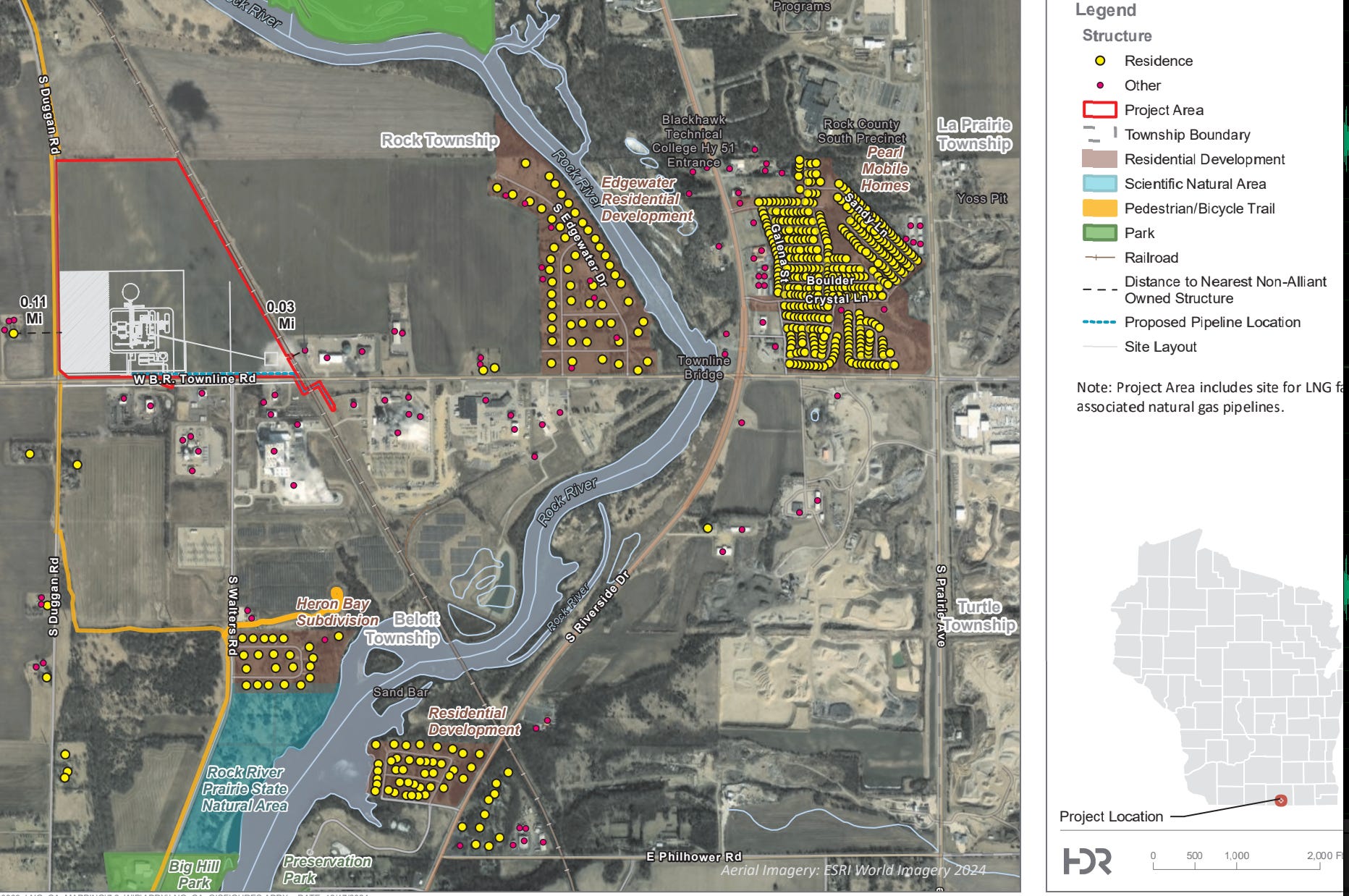
Then there are applications for powering the increasingly-taxed power grid, as utility companies that are experiencing in increase in demand rush to increase their supply. Wisconsin Power and Light (parent company: Alliant) is pursuing an application to build a liquid natural gas plant in the town of Afton. The proposed site is located just two miles from the area mapped in DNR filings by the Meta shell corporation. It’s a four-minute drive west along W B R Townline Road.
The plant, says WPL (Alliant), will meet their forecast peak demand for natural gas. It would be two billion cubic feet, or 25 million gallons, and cost roughly $694 million. It would be filled in non-peak periods, when natural gas prices are lower, and discharged in the winter when prices peak.
WPL says it doesn’t currently operate an LNG storage facility, but similar facilities have been safely operated across the country for years, with two already running in Wisconsin. If approved, the project would be complete by January 2030.
Public comment is mostly not friendly to the project, citing Janesville and Beloit’s poor air quality and asthma rates. Among them, Yusuf Adama, the Beloit councilmember, who wrote last summer: “Beloit and the surrounding region already bear the burdens of industrial pollution and poor air quality. Adding a massive LNG facility would only exacerbate these issues, increasing health risks for residents — especially children, the elderly, and those with pre-existing respiratory conditions.”
Next Monday, the Town of Rock’s Planning and Zoning Committee will hold a public hearing over whether to issue a conditional use permit to build the plant. Unpacking how and why zoning in Rock County is left almost completely to municipalities, not the county, is a story for another time.
Email cutting off? Read it online.
A data center legislation cheat sheet
Eight months out from the November election, the Wisconsin Legislature has finished up its regular lawmaking for the year. More could still pass in one or more special sessions, but it’s likely the next time legislators will tackle any data center questions is in 2027.
Data centers and utility regulation will almost certainly be an issue in the governor’s race this summer. I thought this would be an appropriate point to map the various data center proposals this session, which have generated so many headlines but little follow-up. This list ignores data center legislation before 2025.
A moratorium on data centers
- Read it: Senate Bill 1061 / Assembly Bill 1099
- What it would’ve done: The bill would’ve imposed a moratorium on data centers in Wisconsin until a broad swath of proposals are enacted: in utility and water regulation, voter sign-off, and the elimination of fiscal measures.
- The politics of it all: Progressives loved it, but it was unlikely to pass a legislature that approved tax breaks for data centers in 2023.
- Where did it land? The bill failed. It didn’t get a hearing in either chamber.
Large energy customer fees
- Read it: Assembly Bill 722 / Senate Bill 729
- What it would’ve done: The bill is a smorgasbord, but it would have outlined specifics for “large load” energy customers. It said that in order to qualify for tax breaks, qualified data centers would need to get certified, and be powered by at least 70% renewable energy. It also would’ve set minimum wages for labor and required water use reports from data centers.
- The politics of it all: Democrats, led by Sen. Jodi Habush-Sinykin, introduced this bill last fall, just after polling showing that data centers are unpopular in Wisconsin. It was an attempt to address common concerns listed by communities and those opposed, and had the support of environmental groups and labor. In testimony, Alliant Energy pointed out that the Public Service Commission is already charged with fair rate-making, and the legislation lacked clear definition.
- Where did it end up? The bill failed. It got a hearing in the Senate, but didn’t make it out of either committee.
Requirements related to data centers
- Read it: Assembly Bill 840 / Senate Bill 843
- What it would’ve done: This is the Republican answer to the Democratic bill described above. It contains less technical language, but also requires that the PSC ensure consumers don’t feel squeezed in their electric bills because of data centers. It also requires that renewable energy projects serving data centers be located on-site, which is a high bar to clear. It also requires annual reports on data center water use and for data centers to use closed loop systems.
- The politics of it all: More than two dozen groups registered on the bill, but no one registered in favor of it. In public hearing, the Janesville City Manager testified in support of most of the provisions, but objected to requiring closed loop water systems. The Public Service Commission took the unusual step of testifying, saying it was largely redundant legislation but that the “the terminology used in the proposed bill could invite litigation and cause confusion.”
- Where did it end up? It passed the Assembly, 53-44, in January. It passed through two committees in the Senate, but didn’t get a final vote.
Prohibiting NDAs
- Read it: Assembly Bill 1036/ Senate Bill 969
- What it would have done: It would have prohibited nondisclosure agreements intended to conceal information about a data center from the public.
- The politics of it all: Wisconsin Manufacturers and Commerce opposed the bill, characterizing NDAs as a common economic development tool. “Companies and developers routinely request NDAs to protect proprietary information, trade secrets, financing strategies, and competitive site selection criteria until a dealreaches a stage where disclosure will not jeopardize financing, market position, or negotiations in other states,” they wrote in testimony. The Wisconsin Data Center Coalition said, “We support transparency. We oppose a blanket ban.”
- Where did it end up? The bill failed. It passed through a Senate committee, but didn’t get a hearing in the Assembly.
TIF Districts containing data centers
- Read it: Assembly Bill 228/ Senate Bill 241
- What it would have done: Currently, the Legislature needs to specially approve instances where local governments want to exceed the “12 percent rule” for tax increment financing, or TIF. Local governments need to ask lawmakers for approval to put more than 12% of its total property value inside TIDs. This was approved, for example, in Beaver Dam and Port Washington. This bill would have eliminated that requirement to ask the Legislature each time, for data center projects only, to exceed the cap.
- The politics of it all: Data centers, utility companies, and business groups lobbied in support.
- Where did it end up? The bill failed. It didn’t get a hearing in either chamber.
Local approval for wind and solar projects
- Read it: Assembly Bill 7 / Senate Bill 3
- What it would have done: Right now, the PSC has the authority to site wind and solar projects. They don’t have to take local zoning into account for projects of a certain size. This bill would have changed that, requiring the PSC to get the permission of local governments before siting a project.
- The politics of it all: Renewable energy projects, which use large amounts of land, are themselves controversial in rural communities. But if enough local governments say not in my backyard, then there’d be few places to build renewable energy projects. You see the rub?
- Where did it end up? The bill failed. It didn’t pass out of either committee, but did get a hearing in the Senate.
Expanding tax credits to co-located data centers
- Read it: Senate Bill 244 / Assembly Bill 245
- What it would have done: Remember those 2023 tax breaks for “qualified” data centers? There are rules for which types of data centers qualify, and currently, the tax breaks leave out “co-located data centers.” These were described to me as a like a data center condominium. There are multiple tenants, renting space, within a larger facility.
- The politics of it all: This bill was introduced by Sen. Romaine Quinn and Rep. Shannon Zimmerman, who also played a key role in getting the original data center tax breaks signed into the budget in 2023.
- Where did it end up? The bill failed. The Assembly Ways and Means Committee approved it, but the powerful Joint Finance Committee did not take it up. It didn’t get a hearing in the Senate.
Competitive bidding for transmission projects
- Read it: Senate Bill 174
- What it would have done: This is a highly technical bill that would have required competitive bidding and audits for major transmission projects. It would’ve limited limiting how much large-scale wind and solar could be built in any one place, and granted utilities first rights to build regional transmission lines.
- Where did it end up? The bill failed. It didn’t get a hearing in the Senate, and a companion bill doesn’t appear to exist in the Assembly.
Lastly, it’s clear that this session the Legislature and the Governor had their eye on another target: nuclear energy, one potential answer to fueling the high energy demands of data centers.
And nuclear energy seems to be somewhat bipartisan. Among this session’s proposals are a nuclear energy generation tax credit (Assembly Bill 472 / Senate Bill 502), a nuclear power siting study (Wisconsin Act 12 / Senate Bill 125), a nuclear power summit (Wisconsin Act 11 / Senate Bill 124), and a sales and use tax exemption for nuclear fusion (Assembly Bill 657 / Senate Bill 636). This last last one passed the Senate earlier this month, but hasn’t been signed by the Governor.
News in brief
- Milwaukee Journal Sentinel: Wisconsin data centers’ water use raises environmental concerns. Reader questions on closed loop systems and wastewater. (Friday, Match 27)
- WISN: What’s that sound? It’s Mount Pleasant’s new AI data center. This is just from my ears, but the tone appears to be the sound that symphony orchestras use to warm up. (Thursday, March 26)
- WIRED: Senators demand to know how much energy data centers use. Liz Warren and Josh Hawley are pressing the Energy Information Administration to collect data on annual energy used by data centers. Nailing that number down has been hard, and, they write, that information is “essential for accurate grid planning.” (Thursday, March 26)
- The New York Times: Local opposition is slowing A.I data centers. Wall Street has noticed. According to Data Center Watch, “at least $156 billion across 48 projects with publicly disclosed values was blocked or stalled amid coordinated local opposition in 2025.” (Thursday, March 26)
- The Atlantic: Welcome to a multidimensional economic disaster. If it’s a bubble, what happens when it pops? (Thursday, March 26)
- WeAreGreenBay: Green Bay leaders discuss AI data centers at UWGB event. Coverage of a forum hosted by an economic development agency. (Thursday, March 26)
- Milwaukee Journal Sentinel: Will Wisconsin residents pay for data center power? The Public Service Commission is expected to decide a rate case from WE Energies in the next month. (Wednesday, March 25)
- The Guardian: Bernie Sanders and AOC introduce bill to pause building of new datacenters. The bill would direct the Secretary of Energy to prepare a report on the finances, water and energy use, emissions, wastewater, noise, labor, jobs, and agreements for each AI data center. It would also require “ certification that the artificial intelligence data center has not utilized any federal, state, or local subsidies.” (Wednesday, March 25)
- MinnPost (opinion section): Google just bought your Minnesota vacationland for a data center. A proposed hyperscaler in Minnesota developed by a Google shell corporation involved 22 non-disclosure agreements, writes Hermantown resident Rebecca Gilbertson. She points out that Minnesota Power/ALLETE was purchased by a subsidiary of BlackRock in October, and BlackRock owns a 5-7% share of Google. (Wednesday, March 25)
- New York Times: Meta and YouTube found negligent in landmark social media addiction case. Echoing a claim about addiction that worked in Big Tobacco litigation, a California jury agreed with the novel legal theory that social media can cause injury. (Wednesday, March 25)
- New York Times:Meta ordered to pay $375 million over child safety violations. Meta plans to appeal. (Tuesday, March 24)
- Wisconsin Watch: Competition intensifies over who builds Wisconsin’s grid as data centers drive power demand. Not directly in the article, but here’s how I think about it: MISO, the Midwest regional grid operator, is like an air traffic controller. They decide which projects can connect to the grid and when. MISO’s reversed a decision for private-equity owned Viridon to build substations in eastern Wisconsin, handing it back to ATC, the nation’s oldest standalone transmission company which is itself owned by utilities. (Tuesday, March 24)
- Big Radio: Utility director says Janesville’s water infrastructure can handle data center needs. Utility Director David Botts says the city only used about 48% of the city’s reliable water resources in 2025. (Tuesday, March 24)
- Crain’s Chicago Business: AI’s expanding footprint comes with a big thirst for water. Lots of good background on projects on other states, along with statistics on projected water use. A common refrain from water experts by now: data centers “double dip” their water use, both cooling chips and in generating electricity necessary for them. (Monday, March 23)
- Wisconsin Watch: Local data center critics praise Microsoft’s pledge to stop using NDAs, but remain skeptical. Microsoft has pledged to stop signing NDAs , and it’s earning measured praise. (Monday, March 23)
- Illinois Farmer Today: Opponents gather to talk about risks of data center. More coverage of the town hall in Beaver Dam earlier this month. (Sunday, March 22)
- 404 Media: Tiny township fears Iran drone strikes because of new nuclear weapons datacenter. The township of Ypsilanti, Michigan, population 20,000, would service nuclear research performed by Los Alamos National Laboratories. Opponents say it puts a bullseye on their home. (Friday, March 20)
- Public News Service: Rural WI faces dual concerns over data centers, CAFOs. They’re both instances of large land uses that are extracting wealth, says an organizer. (Friday, March 20)
Events in brief
- Friday, March 27: Project Lighthouse Career Expo (Port Washington High School, 4-7pm). Vantage and partners will be onsite with more information on open roles, particularly engineering and management.
- Saturday, March 28: Project Lighthouse Career Expo (Port Washington High School, 10am – 2pm). Vantage and partners will be onsite with more information on open roles, particularly engineering and management.
- Monday, March 30: LNG Public Hearing (Afton, WI at 6:30 pm).
The Town of Rock Planning and Zoning Committee will hold a public hearing over issuing a conditional use permit for Alliant (Wisconsin Power and Light) to build a liquid natural gas plant along WBR Townline Road. - Wednesday, April 1: Town Hall on Data Centers and Utility Rates (Virtual via zoom at 6pm). Citizen Action of Wisconsin will hold a town hall on data centers and utility rates. Virtual; register here.
- Wednesday, April 8: Data Centers and the Energy-Water Nexus (Lubar Center, UW-Milwaukee, 9am). A panel on the connection between energy generation and clean water will include Citizens Utility Board, Milwaukee Riverkeeper, and WEC Energy Group; moderated by David Strifling, director of the Water Law and Policy Initiative, and lawyer and professor Art Harrington.
- Tuesday, April 14: Data Centers and a Sustainable Future (Madison, 8am) Sustain Dane will host a breakfast series in Madison on data centers and a sustainable future (note: QTS has maintained its $1.5 million commitment to UW researchers on data center sustainability). Register.
- Tuesday, April 14: Dane County Advisory Committee on Data Centers (Madison, 12pm). Dane County’s advisory committee on data centers will hold its monthly meeting.
- Wednesday, April 22: Data Centers in Grant County (Lancaster, 7pm).
The Grant County Farm Bureau will host an informational meeting on data centers. - Thursday, April 23: ICE and Data Centers (Sheboygan, 6pm).
Labor organizer Ric Urrutia, co-host of the Wisconsin Labor Podcast, will present in Sheboygan on what he terms the “interlocking corporate and banking interests of ICE and data center owners.” More info. - Friday, April 24: ICE and Data Centers (Manitowoc, 4pm). Labor organizer Ric Urrutia, co-host of the Wisconsin Labor Podcast, will present in Manitowoc on what he terms the “interlocking corporate and banking interests of ICE and data center owners.” More info.
- Thursday, April 30: Wisconsin Tech Summit (Oshkosh Corp. headquarters, $$). This year’s annual summit is focused on AI in industry, especially in health care, finance, ag, energy, and manufacturing. Remzi Arpaci-Dusseau, of UW-Madison’s new College of Computing and Artificial Intelligence, will deliver a keynote. Full speaker list here, and more info.
That’s all for now!
This weekly newsletter is attempting to do something a little different: round up the data center news across Wisconsin, and present the patterns that emerge.
I’m starting this out of a personal habit of aggregating developments and data center news, and a way to organize notes for longer research projects. Then I figured, why not share the notes with you?
Thanks for reading Data Processor! Subscribe for free to receive new posts and support my work.